GoodSoundClub's Home
Manifesto Copyright
Statistics Site Links
Site Map Surveys
Send Email to Romy the Cat
A new interesting development of the electromagnets subject… The high-voltage field coils?
Audio Knowledge Tree ™
Romy's "Audio Rules"
Audiophile Satire
Melquiades SET Amplifier
Macondo Acoustic System
End of Life Phonostage
Audio Demoronizator AD-1
My Exotic Audio Leftovers
My Playback System
» How to evaluate playback»
» How audio started….
» A weekend of treats by B»
» Sonic consequences of re»
» “How audio might sound”
» Any South/Latin American»
» Making of a Steinway.
» Getting Started with Mya»
» Rohde & Schwarz EU-6»
» My Audio "Reviewing»
» CES 2006
» Can a ultimate playback »
» How to test 6C33C?
» The LCR RIAA correctors
» Preamplifiers: keys to m»
» The LavryBlack DA11 Ster»
» Rach’s Prelude in C-shar»
» Rachmaninoff, PC 3; Kond»
» The wonder of Ayre Acous»
» The Rafael Kubelík'»
» Internet and electricity
» Copland/BSO/Copland
» Spivakov, NPoR Orchestra»
» Oistrakh(s) on Monitor M»
» The Shielding Condoms on»
» The “Dead Points of Live»
» Multiple EQ curves of A»
» EMI rollercoaster across»
» I have a dream, the drea»
» Wilson Audio and the Moo»
» Custom enclosure?
» The best album of 2005 s»
» Driver Alignment, and Wh»
» Andre Previn in Boston.
» Roomy the cat is going t»
» Vitavox S2 coupling
» The Nationals Anthems
» The SACD and the Windows»
Bookmarked are red
Perer Gulmann's Classica»
Instant Encore
MusicStack
Holger Klein's Soundpage»
The Opera Critic
Rachmaninoff Society
Pianist Yakov Kasman
George Szell discography
Retro hi-fi blog
Silent Running Audio
Valves Collection
Linkwitz's "Laboratory"
More Links »»
Romy the Cat's personal site dedicated to advanced audio and evolved music reproduction techniques

Romy the Cat’s Playback "Rules"

Here is a collection of my personal, highly subjective conclusions about the winning patterns that makes a playback system “to sound”. Certainly they are not “Rules” but rather an assemblage of observations that repeatedly and predictably work for me. I’m not an expert in many fields of the "Rules" but I do have multiple practical conformations in my and otheres listening rooms that the “Rules” do work.

Analog Sources

Cartridges moving coil only. Tonearms are long with excessive affective mass. A few cartridges with different profile needles are good. Whatever turntable used it should not produce the disgusting “ported” bass with hollow tone – the 99% of them do. I prefer very heavy TT with high inertia driven by low torque belts. Whatever type or topology phonocorrector is used it shall give out more gain then needed. The RLC RIAA is better than RC. No records treatment of any kind beside regular washing with alcoholic flue and vacuuming. No cable after step-up transformer, if a transformer is used. No contemporary LP pressing – they are all garbage.

Digital Sources

SACD, DVD-A, XRCD and many other “hi-resolution” formats should not be used. Properly implemented 20-24bit PCM is way more musical than anything else so far commercially supported. Digital is inherently not editable. A RAW 24bit file, right after A/D processor is true pure digital. If the file was expose to ANY further DSP processing, even change 0.1dB of gains is a terminal death of pure digital and birth of digital garbage. Any rate, resolution or format conversion, including putting the file to CD, DVD formats, is terminally killing the file.

Amplification Electronics

An amplifier has to have minimum amount of stages to serve the needed of the given gain. I am an advocate of DSET topology - Dedicated Single-Ended Triode™, The concept DSET implies a narrow-bandwidth parallel operation of the SET channels with an optimization of transformers, operation point, power supplies and other parameters specificity for the needs of the given bandwidths. I advocate no active crossovering around active stages but line-level crossovering integrated with DSET topology.

Loudspeakers

No ports. No dipolar operation in any forms. No synthetic driver’s cones. Wider dynamic range is better but after 110dB/W the Transient/Tone balance rapidly goes down. No impedance equalization, no resonators of any kind. No crossovers more then 6db/octave if possible; in very specific cases higher order might be used but very reservingly, very “creatively” and with the very well-determined purpose. Loudspeakers should have multiple channels and the channel should be painstakingly and meticulously time-aligned not only geometrically but acoustically. Any minute phase discrepancy between the channels religiously tabooed. Loudspeakers should be viewed only in context of their listening environment and should be positioned according the DPoLS concept (search my site for further explanations). The “quality” of the loudspeakers should bear ONLY on the quality of drivers and the loudspeaker design should recognize and to embrace (not combat!) the idiosyncrasies of drivers. Consequentially the design should furnish the best possible environment for the drivers to let them operate at their full natural blossom. Horn loaded loudspeakers are the most advance topology of any loudspeaker. The properly implemented and advanced performing home-based horn-loaded loudspeakers are practically unknown to wide audio public.

They were my very basic principles. If you do not like them then I have others....
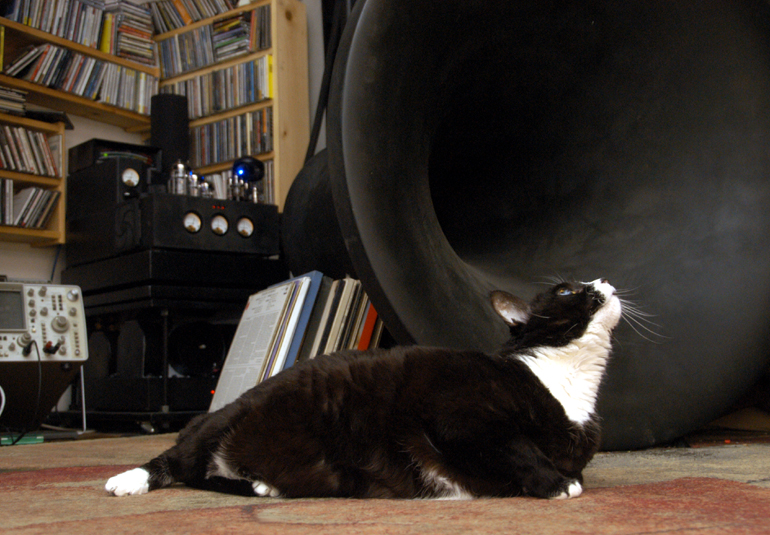
Koshka2009.JPG

All context of this site except the Forum's posts Copyright © Roman Bessnow 2004-2010
All messages within the Site’s Forum Copyright © by authors of the posts
Last 24-hours posts:  9  
Total human visitors:  2,147,817  
   
      Search Site Forum
     Search Site via Google
 
Login:
Pass:
    Create a New Account
    Forgot your Account
MAR 11 Free Thursday Noon L»
MAR 11 Rafael Frubeck de Bu»
MAR 11 Tufts Choruses»
MAR 12 Ariadne auf Naxos»
MAR 12 Mozarts Don Giovanni»
MAR 12 Piano Quintets by Fa»
MAR 12 Tufts Symphony Orche»
MAR 13 Mazurkevich plays Tc»
exclusive first listen: hel»
unearthing mendelssohn's lo»
felix mendelssohn's 'scotti»
felix mendelssohn's genius »
love and lunacy: vivaldi's »
composer, conductor lukas f»
modern music sweep for clas»
russian valentine: prokofie»
how do you win that orches»
music review: stage brims »
s.f. symphony contrabassoo»
roman functionaries stop c»
music review: stage brims »
a 'myth' that's hard to gr»
s.f. symphony contrabassoo»
back in samuel barber's da»
for city opera, 2010-11 to»
reconsidering classical mu»
bantry house»
strolling through castles »
for new york city opera se»
cellist natalie clein take»
More Music News »»
Eberl, Anton (13 June 1765»
Bazzini, Antonio (11 March»
de Lacerda, Francisco (11 »
Vasilenko, Sergey Nikiforo»
Ruggles, Carl (11 March 18»
Wood, Haydn (25 March 1882»
Cowell, Henry Dixon (11 Ma»
Montsalvatge, Xavier (11 M»
Weinzweig, John (11 March »
Piazzolla, Astor (11 March»
Straesser, Joep (Joseph Wi»
Oldham, Kevin (30 August 1»
Huydts, Sebastian Baptiste»
Harris, Elisa (11 March 19»
Micro Seiki RX-5000
Koprvet “Egg” Tonearm
Vitavox AK-15/40 15" ba»
Vitavox 330Hz Horn for »
REL Precedent 646C tuner
Tribute Output Amorphou»
Pacific Microsonics Mod»
Vitavox S2/S3 diaphragms
SME M2 - 12" Tonearm wi»
Rohde & Schwarz EU-6201»
Micro-Seiki MAX-282 To»
More Leftovers »»